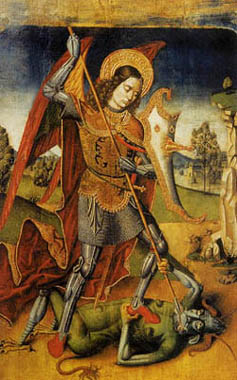
Today is officially the Feast of St. Michael and the Archangels, only one of my favorite days of the year. To say something that will make people think I'm far more conservative than I really am. . . I'm pretty old school about this. Once upon a time, this was simply Michaelmas, the Feast of St. Michael the archangel, while Sts. Gabriel and Raphael had their own days (March 24 and October 24 respectively). They've all been lumped together on this day, now but . . . I really do prefer a separate day for each for two reasons: 1) I think that we should get to know each of these angels as individuals and poor Raphael sometimes gets overshadowed by his more well known siblings and 2) I have a mad, long-term crush on Michael.
Yes, I know, I'm a fan-girl for a lot of things: anime, Jesuits, Firefly, nuns in habits, Jesus, etc. . . but, if you asked me who my number one was, it would be (naturally) God. Number two, though, would definitely be Michael.
I'm sure most of you reading this know the legend of how back at the beginning of time, Michael was instrumental in kicking the rebellious Satan out of heaven. This is, as you know, where he
A lot of other traditions and legends have arisen since then about Michael, and I think today would be a good day to share some of these. . .
Jewish legend (referenced in Jude 1:8) holds that Michael and Satan met up again at the death of Moses, and quarreled over the patriarch's body (Satan contended that Moses was a murderer and not worthy of burial). Jude says of this "Not even the archangel Michael, when he was engaged in argument with the devil about the corpse of Moses, dared to denounce him with the language of abuse; all he said was, 'May the Lord rebuke you.'" *Sigh* A warrior and a gentleman. Goodness knows that if I had been in Michael's position, I would have fallen prey to my sometimes over active tongue, staring out with "Ah, go to hell ya blankety blank blank blankety blank!"
Various sites are recognized for a connection with the angel, such as Mont St. Michel off the coast of Normandy, the Michaelion in Constantinople, Monte Gargano in Italy, St. Michael's Mount in Cornwall, Eusebios in Constantinople, and Chonae in Phrygia. These latter two are notable for showincasing Michael's healing abilities, Chonae especially for it's springs which legend says Michael had a hand in bringing forth.
Michael is considered the defender of the Church and of Christians, and protector against all evil. This is why when Pope Leo XIII had his vision regarding the (at the time, yet to happen) 20th century, he wrote the now popular prayer:
St. Michael the Archangel, defend us in battle;
be our safeguard against the wickedness and snares of the Devil.
May God rebuke him, we humbly pray,
and do Thou, O Prince of the Heavenly Host, by the power of God,
cast into Hell, Satan and all the other evil spirits,
who wander throughout the world,
seeking the ruin of souls. Amen.
Another, more involved prayer is the Chaplet of St. Michael, found here with some other Michaeline devotions.
Here's the prayer set to music (well, kinds), as found on YouTube:
Also, appropriate for today, an old fashioned book-burning over at Kat's place. She's cleaning out her library of things she doesn't want around anymore, but does not feel right about letting others be exposed to, so go ever, and see what you'd like to help rid the world of.
Saturday, September 29, 2007
Michaelmas!!!

Wednesday, August 8, 2007
Women in the Priesthood
If it was women who didn't abandon Christ at the cross, and women who first knew the resurrection, why then can't women be priests?
I will attempt to explain this in such a way that does not devolve into what has been described as the "uterus argument" in some circles, meaning the argument that says that the reason women can't be priests is the same reason men can't get pregnant, it is hardly a dignified argument or response to a serious question. The following is also an explanation of how I personally came to accept church teaching on the matter.
The reasons behind why the church teaches the way it does regarding women in the priesthood are not simple. It has nothing to do with the church believing women are less then or inferior to men. Pope John Paul II in his Letter to Women undeniably reiterated for the modern age the church’s teaching on the dignity of women in which he said:
I know of course that simply saying thank you is not enough. Unfortunately, we are heirs to a history which has conditioned us to a remarkable extent. In every time and place, this conditioning has been an obstacle to the progress of women. Women's dignity has often been unacknowledged and their prerogatives misrepresented; they have often been relegated to the margins of society and even reduced to servitude. This has prevented women from truly being themselves and it has resulted in a spiritual impoverishment of humanity. Certainly it is no easy task to assign the blame for this, considering the many kinds of cultural conditioning which down the centuries have shaped ways of thinking and acting. And if objective blame, especially in particular historical contexts, has belonged to not just a few members of the Church, for this I am truly sorry. May this regret be transformed, on the part of the whole Church, into a renewed commitment of fidelity to the Gospel vision. When it comes to setting women free from every kind of exploitation and domination, the Gospel contains an ever relevant message which goes back to the attitude of Jesus Christ himself. Transcending the established norms of his own culture, Jesus treated women with openness, respect, acceptance and tenderness. In this way he honoured the dignity which women have always possessed according to God's plan and in his love. As we look to Christ at the end of this Second Millennium, it is natural to ask ourselves: how much of his message has been heard and acted upon?
Yes, it is time to examine the past with courage, to assign responsibility where it is due in a review of the long history of humanity. Women have contributed to that history as much as men and, more often than not, they did so in much more difficult conditions. I think particularly of those women who loved culture and art, and devoted their lives to them in spite of the fact that they were frequently at a disadvantage from the start, excluded from equal educational opportunities, underestimated, ignored and not given credit for their intellectual contributions. Sadly, very little of women's achievements in history can be registered by the science of history. But even though time may have buried the documentary evidence of those achievements, their beneficent influence can be felt as a force which has shaped the lives of successive generations, right up to our own. To this great, immense feminine "tradition" humanity owes a debt which can never be repaid. Yet how many women have been and continue to be valued more for their physical appearance than for their skill, their professionalism, their intellectual abilities, their deep sensitivity; in a word, the very dignity of their being!
How is this the same man who was accused by groups such as CTA as being anti-woman and misogynistic?
We have many many years of church history and tradition of an all male priesthood, the one thing that has not changed while other things have such as mass in the vernacular and even the requirement of celibacy (which was not always mandated) both of those things have changed and many other things have changed and been fluid within the church. Yes the church’s stance on women in the priesthood is hard to accept, and hard to swallow because we live in a society that devalues the uniqueness of women and promotes that ‘everything a man can do a woman can to’ in the job field. However, priesthood is not a job, it is a calling from God to serve completely in a certain way it is not a choice in the sense one chooses to be a firefighter or police officer or teacher. Yes God is God and can call whom he chooses but the Church recognizes that while we are limited in our understanding of God and his workings we must err on the side of caution in discerning God’s will. The Church is not subject to the whims of modern society and stands firm on teachings that may lead the faithful away from a greater understanding of Christ and the will of God in our lives. The problem with groups such as CTA etc, that promote women in the priesthood is that they have lost sight of the fact that priesthood is a call to serve and not a call to power, control or authority. Too many of those kinds of groups see the priesthood as a way to gain control over the church, these are the same groups who promote artificial birth control, abortion and euthanasia. We were told that we “shall know them by their fruits” Matthew 7:16.
The fruit of the tree of the church is good fruit, and while we may not all like every part of the fruit of the tree that is the Church, it is good fruit and must accept it as such. We are not called to agree with the Church but we are all called to accept Church teaching. Church teaching is not based on the opinions of John Paul II or Benedict but is based upon 2000 years of history and tradition, prayer and discernment and the leadings of the Holy Spirit no one Pope is going to step in and change that (church teaching in general) overnight. And lest we forget, the church has changed in how it relates to women. Women attended and gave input to the second Vatican council and women are involved in the church from the parish level to the Vatican .
The priesthood is not about power, and anyone who thinks of it as such be they lay or religious, male or female they have the message extremely wrong and need to examine their motivations. The idea that priesthood is power is clericalism at its worst and not a following of the call to be a servant to the servants of God.